
by Michael D. Anestis, M.S.
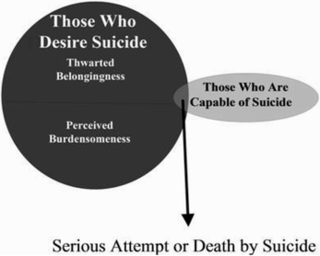
We have spent a fairly significant time on PBB discussing both non-suicidal self-injury (NSSI) and suicidal behavior. When we discuss NSSI, we tend to do so through the framework of Nock and Prinstein's (2004) functional model. When we discuss suicidal behavior, we tend to do so through the framework of Joiner's (2005) interpersonal-psychological model. Today, I would like to discuss an interesting study that examined both forms of behavior, but which was conducted by researchers not directly associated with either of these theories. The results are consistent with what would be expected, but it is nonetheless useful to examine findings produced by independent researchers. In this case, the psychologists responsible for the study, which was published in an upcoming issue of Personality and Individual Differences, are more closely associated with work on negative urgency, another popular PBB topic (Claes et al., 2010).
Claes and colleagues (2010) wanted to examine the degree to which NSSI and suicidal behavior are distinct from one another and to do so with a sample of individuals experiencing severe psychopathology. Additionally, the authors were interested in determining to whether particular personality characteristics, coping styles, and symptoms of psychopathology were predictive of particular behaviors.
Before going any further, let me clarify the meaning of both NSSI and suicidal behavior, as explained by Claes et al (2010):
- NSSI is the intentional infliction of injury to one's own body without any intent to die
- Suicidal behavior is the intentional infliction of injury to one's own body with the intent to die
Intent can obviously be a cloudy topic and, at times, there is definitely ambiguity. After the fact, it can be impossible to determine intent in a number of scenarios, including individuals who overdose, die by means of autoerotic asphyxiation, or die in single car crashes with no skid marks, unless the individual leaves a note indicating that the incident represented a suicide attempt. That being said, these ambiguous scenarios represent the exception rather than the norm and a large body of research is developing through which differences between NSSI and suicidal behavior are emerging (e.g., whereas NSSI is an impulsive action, suicide attempts are not).
Although the research on both NSSI and suicidal behavior offers us substantial insight and has helped in the development of empirically supported interventions (e.g., dialectical behavior therapy), many such studies have focused on relatively healthy undergraduate populations, which raises questions about the degree to which the findings apply to individuals suffering from severe mental illness (the population most likely to engage in these behaviors). That being said, Claes and colleagues (2010) recruited participants for their study from a group of 200 admissions to an inpatient psychiatric crisis unit in Belgium. In total, 128 of those individuals (64%) chose to participate, provided informed consent, and completed the protocol. The average age of the participants was 35.62 and 75% of the participants were female.
In total, 36.7% (n = 47) of the sample reported engaging in at least one form of NSSI (e.g., cutting, burning, scratching, hitting). There were no sex differences on this behavior, meaning that men and women were equally likely to engage in NSSI. 45 participants reported having engaged in at least one suicide attempt during the course of their lifetime. Surprisingly, despite the fact that, on average, women are three times as likely as men to attempt suicide, there were no sex differences for this behavior in this study. This surprising finding, to some degree, is a limitation of the study, as it indicates that the sample might differ from standard samples. Individuals with a history of NSSI were more likely to endorse a past history of suicide attempts than were individuals with no history of NSSI.
In order to test for differences between NSSI and suicidal behavior, the authors divided participants into four groups based upon their past history:
- No NSSI - No suicide attempts (SA) -- 58 (45%) participants
- Only NSSI -- 26 (20.3%) participants
- Only SA -- 23 (18%) participants
- Both NSSI and SA -- 21 (16.4%) participants
Ultimately, the authors were interested in determining whether aspects of personality, severity of psychopathology, and forms of coping would help them predict behavioral patterns, with more severe levels of these predictors indicating a greater likelihood of engaging in suicidal behavior, either alone or in combination with NSSI. Their findings were as follows:
- Patients with a past history of suicide attempts (Only SA or NSSI + SA) scored higher on measures of depression, hopelessness, and suicidal ideation than did individuals with no history of suicide attempts.
- Individuals in the SA+NSSI group scored higher on neuroticism, which is marked by intense and difficult to regulate emotions, than did individuals in any of the other three groups.
- Individuals reporting a history of SA or NSSI exhibited lower levels of extraversion than did individuals in the no NSSI/no SA group.
- Individuals with a history of NSSI scored lower on conscientiousness than did individuals with no history of NSSI
- Individuals in the no NSSI/no SA group scored higher on a measure of active problem solving and self-soothing than did the NSSI+SA group
- Individuals with a history of SA reported more depressive reactions than patients without SA
- Patients with NSSI scored higher on a measure of avoidance behavior and lower on a measure of social support seeking than did individuals with no NSSI
- NSSI+SA individuals reported higher levels of anger directed inwards.
Okay...that is a long list of acronyms and jargon, but what does it actually tell us? In all honesty, I'm not convinced that it adds much to the literature in terms of differentiating between NSSI and suicidal behavior, but it did further highlight that suicidal behavior can have a substantially greater association with depression, pathological personality traits, and other symptoms of mental illness than NSSI. In other words, although NSSI is harmful and predictive of future suicide attempts (e.g., Van Orden et al., 2008), it does seem to represent a fundamentally distinct and less severe issue than suicidal behavior. The authors' main point was that, as clients demonstrate increases in depression, hopelessness, and neuroticism, NSSI might become more likely to shift in severity, with suicidal intent emerging. As such, these appear to be risk factors worth assessing regularly in clients. To be fair, none of those risk factors are particularly earth shattering in nature; however, new empirical evidence supporting the point and derived from a sample including severely mentally ill individuals is always helpful.
What I wish I had seen from this study, which might be an unfair request, is an examination of the functions of self-injury, the frequency of self-injury, and the components of Joiner's theory. Such analyses would enable us to examine whether individuals who engage in NSSI for one reason (e.g., to reduce negative emotions) might be more vulnerable to subsequent suicidal behavior than individuals who engage in NSSI for alternative reasons (e.g., to elicit a response from others). Alternatively, we could have used such data to see whether the frequency or duration of NSSI behaviors accounted for increases in suicidal behavior, perhaps through increases in the acquired capability for suicide.
Ultimately, this study served to provide further support for models linking particular risk factors to NSSI and suicidal behavior and, to a degree, for models that make a distinction between NSSI and suicide attempts. Although none of the findings represented enormous revelations of previously unknown phenomena, the sample was strong and the information provided by the paper remains useful.
If you would like to learn more about suicidal behavior, non-suicidal self-injury, or empirically supported treatments for either behavior, we recommend the following items, all of which are available through our online store of scientifically-based psychological resources:
- Why People Die by Suicide
 by Thomas Joiner
-
The Interpersonal Theory of Suicide: Guidance for Working With Suicidal Clients
 by Thomas Joiner, Kim Van Orden, Tracy Witte, and David Rudd
- Treating Suicidal Behavior: An Effective, Time-Limited Approach
 by David Rudd, Thomas Joiner, and Hasan Rajab
- Understanding Nonsuicidal Self-Injury: Origins, Assessment, and Treatment
 by Matthew Nock
- Dialectical Behavior Therapy with Suicidal Adolescents
 by Alec Miller, Jill Rathus, and Marsha Linehan
- Cognitive-Behavioral Treatment of Borderline Personality Disorder
 by Marsha Linehan
- Skills Training Manual for Treating Borderline Personality Disorder
 by Marsha Linehan
Mike Anestis is a doctoral candidate in the clinical psychology department at Florida State University


 Subscribe in a reader