
by Michael D. Anestis, M.S.
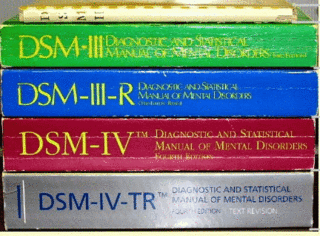
Post-traumatic stress disorder (PTSD) is a debilitating condition worthy of the vast amount of research attention it receives. Few, if any, disagree with this point. That being said, substantial disagreement exists regarding the ideal set of criteria to be used in determining whether or not an individual is, in fact, suffering from this disorder. As committees meet to discuss the upcoming DSM-V, this issue is picking up steam and, in the current issue of the Journal of Traumatic Stress, a number of psychologists put forth arguments for how they believe the DSM-V criteria for PTSD should look. Before discussing their points, let's first take a look at the PTSD criteria as they are in the current diagnostic guide, the DSM-IV (p.467):
*********
Criterion A: The person has been exposed to a to a traumatic event in which both of the following were present -- the person experienced, witnessed, or was confronted with an event or events that involved actual or threatened death or serious injury, or a threat to the physical integrity of self or others
- the person's response involved intense fear, helplessness, or horror (in children, can be expressed through disorganized or agitated behavior)
- recurrent and intrusive distressing recollections of the event, including images, thoughts, or perceptions (in children, repetitive play may occur in which themes or aspects of the trauma are exposed)
- recurrent distressing dreams of the event (in children, there may be frightening dreams without recognizable content)
- acting or feeling as if the traumatic event were recurring (includes a sense of reliving the experience, illusions, hallucinations, and dissociative flashback episodes, including those that occur on awakening or when intoxicated)
- intense psychological distress at exposure to internal or external cues that symbolize or resemble an aspect of the traumatic event
- physiological reactivity on exposure to internal or external cues that symbolize or resemble an aspect of the traumatic event
- efforts to avoid thoughts, feelings, or conversations associated with the trauma
- efforts to avoid activities, places, or people that arouse recollections of the trauma
- inability to recall an important aspect of the trauma
- markedly diminished interest or participation in significant activities
- feeling of detachment or estrangement from others
- restricted range of affect (e.g., unable to have loving feelings)
- sense of a foreshortened future (e.g., does not expect to have a career, marriage, children, or a normal life span)
- difficulty falling or staying asleep
- irritability or outbursts of anger
- difficulty concentrating
- hypervigilance
- exaggerated startle response
Criterion E: Duration of the disturbance (symptoms in Criteria B, C, and D) is more than 1 month
Criterion F: The disturbance causes clinically significant distress or impairment in social, occupational, or other important areas of functioning
**************
Of all the DSM diagnoses, this one might be the most wordy, but that is besides the point. The criticisms of PTSD stem not from its diagnostic wordiness, but rather contentions that several people have about particular criteria, as well as the underlying nature of the disorder itself. With respect to that latter point, some individuals claim that the PTSD diagnosis pathologizes normal distress. In other words, it is perfectly natural for people to become upset after something traumatic happens, but such distress will run its course naturally. Research has shown, however, that individuals diagnosed with PTSD often still meet criteria many years later (e.g., Morgan, Scourfield, Williams, Jasper, & Lewis, 2003). Such findings indicate that, while being upset by trauma is normal, extreme responses exist that require clinical attention.
Other critiques of PTSD center on the symptom overlap it shares with other diagnoses. This, of course is not a problem unique to PTSD. Many anxiety disorders share criteria with one another (e.g., avoidance behavior) and generalized anxiety disorder and depression exhibit a substantial amount of symptom overlap. Nonetheless, the point remains that, to some degree, the PTSD diagnosis might include symptoms that are reflective of overall distress or another diagnosis rather than simply applying to this one specific disorder.
A third critique - the one that has been subject to the most attention - is the inadequacy and utility of Criterion A. In other words, a substantial number of people question whether the diagnosis of PTSD should actually require exposure to a specific traumatic event and a response to that event that was characterized by extreme fear, horror, or hopelessness. Some people argue that this criterion prevents people who meet all other criteria from receiving a legitimate diagnosis and subsequent treatment. Others argue that the broadening of the definition that occurred with the publication of DSM-IV has led to a "criterion creep," allowing for diagnoses of individuals who were exposed to traumatic events that are not viewed as legitimate causes of PTSD (e.g., watching frightening Halloween television programs, losing cattle to foot and mouth disease; Rosen & Lilienfeld, 2008). Research conducted by Breslau and Kessler (2001) revealed that the broadening of Criterion A did, in fact, result in an increased number of PTSD cases, but that the vast majority of those new cases involved individuals learning about the sudden unexpected death of a loved one.
All this being said, there is a fairly strong movement afoot to remove Criterion A in DSM-V. When I first heard this, I was highly skeptical and, in fact, in discussions I have had on this topic with my students in Abnormal Psychology, we have often come to a consensus opinion that this move would not make sense. After reading two articles (one on each side of the argument) in this special issue of the Journal of Traumatic Stress, however, I actually have now changed my opinion. My goal with the rest of this article is to explain the proposed models of these two articles and their justification so that you can make an informed decision as well and lend your voice to the discussion.
Brewin, Lanius, Novac, Schnyder, & Galea (2009)
Brewin and colleagues (2009) propose that the DSM-V should eliminate Criterion A and, in doing so, refocus the diagnosis of PTSD around a specific set of core symptoms unique to this particular disorder. They argue that no other mental illness requires a specific etiology and that, in fact, demanding that a disorder be prompted by a single environmental event while excluding the roles of characteristics of the individual and the interaction of personal characteristics with environment is an overly simplistic way of thinking about mental illness. Indeed, this does seem to discount the idea of the diathesis-stress model. Not everybody responds to the same event in the same way or views particular events as equally traumatic, so requiring a specific triggering traumatic event introduces substantial bias to the diagnostic criteria and shifts focus away from the degree of suffering being experienced by the client. They also argue that, after three revisions of this criteria, we still find ourselves unable to articulate a description that ensures that all appropriate cases are included and all inappropriate cases are excluded. There is little reason to believe this would change in DSM-V.
In the field trials for DSM-IV (Kilpatrick et al., 1998), adjusting the definition of Criterion A to include low magnitude events had almost no impact of prevalence rates. In other words, by creating a situation in which a specific trigger does not have to be identified and events not typically considered traumatic were included, the researchers running the field trial actually did not cause a steep increase in PTSD diagnoses.
Brewin and colleagues (2009) thus believe that, in the DSM-V, PTSD should be based around the core phenomenon of "re-experiencing in the present, in the form of intrusive multi-sensory images accompanied by marked fear or horror, an event now perceived as having severely threatened a person's physical or psychological well-being." In other words, if the individual is having flashbacks of past events, the core of the disorder is present whether or not the individual can identify a specific event that prompted all of his or her symptoms and a response to that event that involved specific emotions. Doing this places an emphasis on the symptoms that are present and are unique to PTSD rather than the individual's recollection of past events and feelings. In this sense, we would become more concerned with treating what is present than in discussing what occurred in the past. To me, this sounds eerily familiar to one of the main arguments for why empirically supported treatments such as cognitive behavioral therapy outperform old fashioned therapeutic approaches like psychoanalysis for so many diagnoses. If people are suffering, it does not matter why as much as it matters how they are suffering and what can be done to improve that individual's quality of life. If PTSD symptoms are induced by something that most people would not view as traumatic...who cares? Perhaps individual differences in variables such as distress tolerance cause particular individuals to experience particular events as more problematic than others. If such individuals exhibit the same core symptoms and will respond to treatment just as well, why not include them in the diagnosis?
Kilpatrick, Resnick, & Acierno (2009)
A second article in the same issue of the Journal of Traumatic Stress arrived at an entirely different conclusion. Like Brewin and colleagues (2009), Kilpatrick and colleagues (2009) acknowledged the imperfections of the PTSD diagnosis and contested the notion of "criterion creep;" however, they believe that the core nature of PTSD requires Criterion A and that revisions are a better answer than elimination.
Their rationale for this suggestion centered on a number of specific points. First, because they believe that PTSD is a disorder that does not occur spontaneously and always follows exposure to some stressful event, removing Criterion A would be inconsistent with the nature of the disorder. Second, they believe that, because the DSM-IV field trails revealed that few people meet the other criteria for PTSD without meeting Criterion A, it makes more sense to simply increase flexibility to include the few cases that might otherwise get lost rather than eliminating the criterion altogether. Third, the authors argued that the better focus is on which events are most likely to induce PTSD, rather than which events should qualify. Ultimately, the authors also argued that revision would allow for a DSM-V criteria set more consistent with prior research on the topic.
Ultimately, these authors acknowledged the imperfections, but believe that revising the criteria while remaining consistent with the research already conducted on this issue makes more sense than a massive reboot of the construct involving elimination of Criterion A.
My thoughts
Reading through these discussions, I was surprised to find myself suddenly agreeing with the idea of eliminating Criterion A. My basis for this opinion change is a shifting understanding of the real question here. The bottom line is, diagnoses serve to recognize suffering and to determine which individuals are ideal candidates for particular treatments. As such, the priority should be on maximizing our ability to reliably and validly identify suffering, not on determining a particular event that prompted the symptoms in the first place. Unless research indicates that particular prompting events result in differential responses to particular treatments, what is the point in being hung up on the prompting event? If it is there, and it likely is in the vast majority of cases, it will be clear in the client's flashbacks and nightmares and can thus be adequately addressed in treatment.
My shifting opinion was not only influenced by the compelling arguments of Brewin and colleagues (2009), but also by some weaknesses I saw in the Kilpatrick et al (2009) argument. In their first rationale for revision instead of elimination, they said that PTSD is a disorder that does not occur spontaneously. First of all, this is an assumption. Secondly, it is circular reasoning. Essentially, this argument says "because the criteria currently say that PTSD is caused by a specific event, we can not change the criteria such that they do not require a specific event, otherwise that would be inconsistent with criteria that require a specific event." Regardless of the strength of the argument, however, if it is impossible to experience the symptoms of PTSD without Criterion A, than what is the point of including it in the diagnostic criteria? Doesn't this logic imply that, if Criteria B-D are met, Criterion A is all set? Additionally, although I value incremental steps in research that build off of one another and help to develop a nomological net, the desire to remain consistent with prior literature is not a rationale for ignoring changes based upon evidence. Consistency only has value when we are being consistently accurate.
I also found myself a bit taken aback that the results of the DSM-IV field trials were used to support the conclusions of both studies. In other words, authors on two completely opposite sides of an argument both cited the same piece of evidence as supporting their case. This either speaks to a lack of quality in the evidence, or a misunderstanding of the data by some or all of the authors.
Given that my opinion on this matter has shifted drastically, I am not at all convinced that it will not shift back as I read more on the topic. In the meantime, I am curious what you think about this situation. Should Criterion A be a part of the PTSD diagnosis in DSM-V?
*****************
If you would like to learn more about PTSD and its treatment, we recommend the following items, all of which are available through our online store of scientifically-based psychological resources:
- Prolonged Exposure Therapy for PTSD: Emotional Processing of Traumatic Experiences Therapist Guide
 by Edna Foa, Elizabeth Hembree, and Barbara Rothbaum
- Cognitive Processing Therapy for Rape Victims: A Treatment Manual
 by Patricia Resick and Monica Schnicke
- Prolonged Exposure Therapy for Adolescents with PTSD Emotional Processing of Traumatic Experiences, Therapist Guide
 by Edna Foa, Kelly Chrestman, and Eva Gilboa-Schnechtman
- Reclaiming Your Life from a Traumatic Experience: A Prolonged Exposure Treatment Program Workbook
 by Barbara Rothbaum, Edna Foa, and Elizabeth Hembree
Mike Anestis is a doctoral candidate in the clinical psychology department at Florida State University