
by Michael D. Anestis, M.S.
*UPDATE -- The October issue of the Behavior Therapist is now available online at the following link*
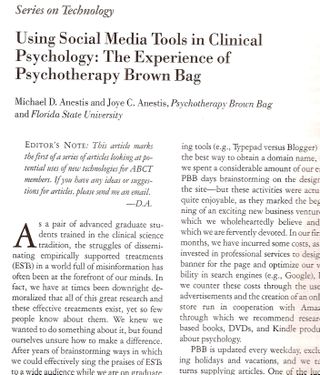
Joye and I were thrilled yesterday when we opened our mailbox to find our copies of the October issue of The Behavior Therapist. We enjoy reading this journal in general - eight complementary copies are released each year - but this one was a little different. An article we wrote about the experience of Psychotherapy Brown Bag and our view of the utility of social media tools in clinical psychology appears in this issue as the first of a number of articles on the topic of using technology to advance the public's knowledge of mental illness and the various treatments available.
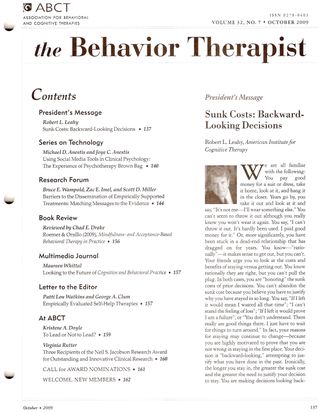
Any time we see one of our articles appear in a journal it is a thrill, but this one is a bit different, as it marks the first time PBB has been the subject of work evaluated by peers. This site is a true passion of ours and, whether or not we fully accomplish our goals with it, we believe wholeheartedly in the cause it represents. We have several desired outcomes with respect to this article, but two of the most central are:
- To help increase the degree to which scientifically-minded clinical psychologists think about and utilize technology in an effort to spread the word about research. As much as nerds like us want research to be an inherently interesting topic that people seek out on their own, that simply is not the case. We have to create a market for it and publicize it in as many ways as possible in order to connect those in need with the information most likely to help them find effective care and better understand whatever mental illnesses might be impacting their lives or those of their loved ones.
- To introduce more people to PBB. If you browse our site and are interested in it, we want to hear from you. If you want to write guest articles on your research or the work of others, we want to hear from you. If you think our site is in some way misrepresenting something, we want to hear from you on that too. Ultimately, this project is about expanding the conversation on topics that are generally only discussed within the halls of academia. Let's take this opportunity to bring more people into the fold and discuss things in a way that helps everyone better understand what is going on.
Before signing off on this topic, Joye and I would like to extend a warm welcome to readers who might stumble upon our site after reading the article. To catch you up on what has happened on PBB in its first seven (nearly eight) months:
- Every weekday, we post a new article (other than holidays and the occasional vacation). Some of these articles discuss a single study. Other articles cover broader topics and reference a number of studies. All of our articles are based upon empirical research and, although we certainly have opinions and biases, our goal is to present the evidence as it is rather than painting one-sided pictures of issues. We want readers to be able to digest all of the relevant information and make informed choices. Comments that present evidence that contradicts the findings we report are more than welcome.
- On the first weekday of each month, we publish a featured article by a prominent professional from the field (clinicians, researchers, etc...). Prior featured authors include Robert Leahy, Jill Holm-Denoma, Katie Gordon, Sarah Fischer, Craig Bryan, and many others. For the upcoming months, we have secured contributions from several exciting authors.
- Our "EST clinics" page is a registry of clinics and clinicians nationwide who provide empirically supported treatments for mental illness. We are always looking to expand the list further, but we hold off on adding new resources until representatives of that location give us approval. If you have suggestions for additions, please let us know.
- Our "Assessment tools" page is a list and description of psychometrically sound assessment tools for a number of diagnoses, conditions, traits, etc...We include references to help readers obtain copies of the measures.
- Any time you see a word or phrase in blue, you can click on it and be redirected to other articles we have written on that particular topic.
When PBB is at its best, readers engage with the articles through the comment section and conversations emerge. Those conversations then lead to follow-up articles and the conversation expands from there. We hope that you find the site compelling, share your thoughts, subscribe to the feed, join us on Facebook or Twitter, and let us know what might be improved. Although we can not guarantee publication to individuals interested in contributing guest articles, we are always excited to hear from people who think they might like to write something for the site. If you think this applies to you, feel free to email us at:
and
PBB is certain to evolve as time goes on and our circumstances change. As we move forward, we hope to provide you with informative and, at least on occasion, entertaining material that keeps you wanting to come back for more. In the meantime, we again welcome you to our site and we look forward to hearing from you.
Mike Anestis is a doctoral candidate in the clinical psychology department at Florida State University


 Subscribe in a reader