
by Michael D. Anestis, M.S.
So far, this weekend has not fallen short in terms of nerd fun. I spent the entire day at the conference yesterday, bouncing from talk to talk and browsing the various poster sessions and attended one talk this morning as well. There is no way I could summarize all of the work I encountered throughout the day and, if I tried, I suspect it would not be the least bit interesting, but here are a few of the highlights thus far...
********
In a clinical grand rounds presentation entitled "Cognitive Restructuring versus Cognitive Diffusion," Robert Leahy (author of the March 2009 PBB featured article) and Steve Hayes demonstrated cognitive behavioral therapy (CBT) and acceptance and commitment therapy (ACT) techniques on the same "patient" (actually an actress pretending to be a depressed women who recently ended a five year relationship). Both of these treatments have an impressive evidence base indicating that they are useful in treating depression, but the demonstration helped to clarify the substantial differences between the two types of therapy. Leahy and Hayes are luminaries in the field and pioneers in these two approaches, so this experience was extremely valuable. My inexperience with ACT admittedly make it somewhat difficult to connect with the abstract approaches used by Dr.Hayes in this presentation, but it left me highly motivated to learn more about the specific techniques involved in this approach. A key quote from each therapist that helped explain some of the basic tenets of CBT and ACT:
Leahy (CBT): "Sometimes we believe something so strongly we don't even bother to check out the facts."
Hayes (ACT): "We want people to look at the process of thinking and not have it dominate how they act."
********
In an invited address entitled "Aaron T.Beck in discussion with Steve Hollon and Robert Leahy - An intimate look at the past, present, and future of cognitive therapy and its founder," a packed house listened to these three incredibly influential psychologists discuss a wide variety of issues. It was an absolute pleasure to listen to Dr.Beck - the creator of cognitive therapy - as he discussed his early days as a neurologist, his training in psychoanalysis and subsequent break from that school of thought, and his early days as a pioneer in the use of data to drive our conceptualization and treatment of mental illness. The talk covered way too many topics to summarize, but I did manage to ask a question relevant to recent PBB discussions.
I asked the presenters how they respond to individuals who claim, despite evidence to the contrary, that specific forms of treatment and treatment techniques are not important and that common factors (e.g., therapeutic alliance) account for client improvements in therapy. We have discussed therapeutic alliance, Wampold's meta-analyses, and the dodo bird hypothesis in prior articles, but Steve Hollon and Aaron Beck provided me with answers that really added a lot to our conversations on this topic:
Steve Hollon mentioned data (sadly, I do not have the citation at the moment) indicating that, while common factors account for a substantial amount of change for individuals with mild symptoms of mental illness, their impact decreases progressively as severity increases. In other words, for somebody with sub-clinical or mild mental illness, common factors are highly influential in treatment outcomes whereas, for individuals with severe mental illness, they are still important but account for substantially less of the progress made in therapy.
Aaron Beck mentioned data (again, since this was a conversation in a large presentation, I do not have a citation) indicating that therapy that centers on common factors can result in quick reductions of symptoms and a sense of well-being, but that these effects are not maintained long term, whereas cognitive therapy routinely demonstrates long term benefits. So, a good alliance can help us feel better, but it can not keep us feeling better on its own. The skills developed through specific forms of therapy with empirical support (e.g., CBT for depression) thus appear to bestow a lifelong benefit upon the client, offering him or her a chance to not only feel better, but apply skills in times of need to prevent symptoms from coming back. Think of this as akin to the teach a man to fish versus give a man a fish saying.
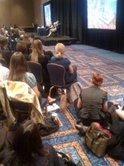
Here is an awful photo taken from my phone before I managed to find a seat:
********
I browsed a large number of poster presentations covering a broad spectrum of topics and discussed the research as well as PBB with many of the presenters. Hopefully, a number of these presenters will write up their findings for PBB readers in the coming months.
********
I was honored to receive the Leonard Krasner Dissertation Award at the awards ceremony last night. This was a truly wonderful and humbling experience. It is not every day you get to hear folks like Robert Leahy talk about you at the same event they discuss major awards won by Edna Foa, Philip Kendall, and several other incredibly impressive psychologists. I will look back fondly on that event for a long, long time.
********
This morning, I attended a panel discussion entitled "Taking CBT, DTC: Direct-to-consumer marketing of evidence-based interventions." David Barlow, Matthew Sanders, Jeff Szymandski, and another panelist (one of the founders of PREP - he was a last second replacement for his colleague, Scott Stanley, but I do not have his name) appeared on the panel and discussed the importance of marketing empirically supported treatments and how to do it. This is obviously an important topic for PBB and it was a pleasure to hear tips and thoughts from people in the field. Perhaps the most telling quote came from Dr.Sanders, who said "most consumers don't know what participation in an evidence-based program looks like or feels like." In other words, when we talk about these programs that we know work, we often forget that they are foreign to many people who could actually benefit from them. Additionally, we sometimes for get that, as we present evidence, some people are not yet versed in what evidence means and why it is important and relevant to them. This speaks directly to our mission here at PBB and we hope that, as time goes on, we help readers to connect with this issue.
********
We may have some more updates from the conference soon - Joye is on a panel tomorrow morning - but when and if that will happen is unclear at the moment. In the meantime, we hope everyone is enjoying their weekend and that you will share your own experiences and/or questions about the conference.
If you would like to learn more about the topics discussed on PBB, we hope you will consult our online store of scientifically-based psychological resources.
Mike Anestis is a doctoral candidate in the clinical psychology department at Florida State University

 Subscribe in a reader