
by Michael D. Anestis, M.S.
A substantial proportion of the population consumes alcohol on occasion. Of those individuals, only a small number eventually develop a substance use disorder (SUD), although even that small percentage is troubling enough to deserve diligent research attention. The question that a situation like this raises is: of those who drink, who is most vulnerable to problematic outcomes? A number of variables could theoretically impact the answer to that question, including a family history of substance use disorders, the presence of mental illness, the context within which an individual drinks, and an individual's motivation for drinking. Drinking motives are a particular interest of mine and you might recall from our previous discussion of Cooper's Drinking Motives Questionnaire that some researchers have broken drinking motives into three distinct categories:
- Drinking to cope with negative emotions
- Drinking to enhance positive emotions
- Drinking for social reasons
In that discussion, we mentioned that drinking to cope with negative emotions is most predictive of alcohol use problems.
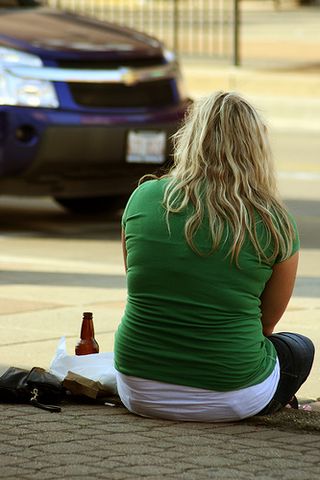
A similar line of research has considered the impact of drinking alone versus drinking in social contexts. Such studies have found that individuals who engage in solitary heavy drinking are more likely to be depressed and to experience alcohol use problems than are individuals who engage in social heavy drinking (Christiansen et al., 2002).
In a study published in Addictive Behaviors by Vivian Gonzalez, Lorraine Collins, and Clara Bradizza (2009) of the Research Institute of Addictions and the University of Buffalo, the authors sought to combine these lines of research to develop a better understanding of how drinking context (e.g., alone versus socially) and drinking motives (e.g., drinking to cope versus drinking for social reasons) related to depression and suicidal ideation. To do this, they recruited 91 underage college drinkers between the ages of 18 and 20. All participants reported drinking at least four alcoholic beverages within the past month and positively endorsed the item "in the past, have you thought it would be better if you were not alive." These inclusion criteria ensured that all participants were drinkers and that they had experienced at least mild, passive suicidal ideation at some point in their lives.
The authors detailed several hypotheses:
- Suicidal ideation would be associated with frequency of solitary heavy drinking but not social heavy drinking, controlling for the effects of depression
- Solitary heavy drinking would be associated with drinking to cope with negative emotions
- Social heavy drinking would be associated primarily with drinking to enhance positive emotions
So, the picture that the authors anticipated seeing was as follows: individuals who drink heavily alone will be more likely to think about suicide than will individuals who drink heavily with peers, and this situation will not be better accounted for by symptoms of depression. Additionally, individuals who drink heavily alone will report that their drinking is motivated primarily by the desire to diminish negative emotions whereas individuals who drink heavily in social contexts will report that their drinking is motivated primarily by the desire to enhance positive emotions.
48.4% of the sample reported that they had drank alone at least once in the past month, while 25.3% of the sample reported drinking heavily while alone during that time period. Individuals who reported solitary heavy drinking engaged in heavy drinking 62.8% more frequently than did individuals who reported only social heavy drinking.
Suicidal ideation but not depression was associated with solitary heavy drinking. In other words, the more often an individual drank heavily while alone, the more they thought about suicide (depression levels, however, were not impacted by the frequency of solitary heavy drinking). Neither depression nor suicidal ideation demonstrated a significant relationship with social heavy drinking. Drinking heavily with peers was associated only with enhancement motives, whereas drinking heavily while alone was associated only with coping motives. So, all of the authors' hypotheses were supported by the data.
What does this tell us? Primarily, it highlights the danger of solitary heavy drinking, as such behavior was highly associated with thoughts of suicide. Additionally, it demonstrated that heavy solitary drinking is typically motivated by the desire to reduce negative emotions, a motive previously linked to problematic outcomes. Importantly, these findings do not indicate that all individuals who drink while alone will think of suicide or that individuals who drink with peers are immune to suicidal ideation. They simply point out that drinking heavily while alone is more frequently associated with problematic drinking outcomes and suicidal ideation than is drinking heavily with peers.
There were a couple of surprising findings in this study. First of all, the fact that depression was not associated with drinking heavily alone is inconsistent with what I expected to see. The correlation between depression and suicidal ideation was substantial, so I do not believe this reflects problematic data, but the finding is nonetheless contrary to expectations. Additionally, it is somewhat surprising that drinking motivated by social reasons was not associated with drinking heavily in social contexts. This might simply mean that social motives predict social drinking, but only when drinking is motivated by the desire to enhance positive emotions does that drinking escalate to "heavy" levels.
One of the underlying points of this study - that drinking alone is associated with increased suicidal ideation - is consistent with Joiner's interpersonal-psychological theory of suicidal behavior, as one of the components of the desire for suicide in that model is "thwarted belongingness," which is defined by a sense on the part of an individual that he or she lacks meaningful connections to others. Drinking heavily alone may, in fact, reflect that particular individuals who are upset feel that they do not have social resources to which they can turn. As a result, those individuals develop the belief that they are left to drink on their own and this isolation could no doubt lead to thoughts of suicide.
Ultimately, perhaps the greatest contribution of this study is a reminder that not everyone who engages in a particular behavior does so for the same reason and that the reason for engaging in a behavior is an important consideration (remember, this applied in our discussion of Nock and Prinstein's functional model of non-suicidal self-injury as well). Additionally, the context within which an individual utilizes a behavior is important to consider and, the more often the behavior is engaged in alone in a secretive manner, the greater the likelihood that the behavior will be associated with problematic outcomes.
************
If you would like to learn more about suicidal ideation and behavior, we recommend the following items, each of which is available through our online store for scientifically-based psychological resources:
- Why People Die by Suicide
 by Thomas Joiner
- The Interpersonal Theory of Suicide: Guidance for Working With Suicidal Clients
 by Thomas Joiner, Kim Van Orden, Tracy Witte, and David Rudd
- Treating Suicidal Behavior: An Effective, Time-Limited Approach
 by David Rudd, Thomas Joiner, and Hasan Rajab
Mike Anestis is a doctoral candidate in the clinical psychology department at Florida State University


 Subscribe in a reader