
by Michael D. Anestis, M.S.
In a couple of recent articles, we have spent some time talking about the importance of considering how we measure particular ideas in research. Specifically, we have discussed data that compares self-report questionnaires to behavioral measures (click here and here for recent examples). Today, I would like to extend that conversation by looking at a recent article published in Psychiatry Research by Irene Janis and Matt Nock (2009). Some of you might remember that we covered another article by this pair last year, which you can access by clicking here.
In the article I will discuss today, Janis and Nock wanted to take a closer look at whether or not individuals who engage in non-suicidal self-injury (NSSI) are actually more impulsive that those who do not. On a number of occasions here on PBB, I have discussed the point that the idea of "impulsivity" is very broad and touches upon a number of distinct and meaningful smaller ideas. In fact, I encourage you to read our prior work on the UPPS-P Impulsive Behavior Scale to get a better sense of what I mean by that point. Ultimately, I will return to this idea at the end of today's post, but it is something for you to keep in mind as we discuss the results of this particular paper. As you do, please note that there is an extensive history of research linking self-reported impulsivity to NSSI.
Anyway, Janis and Nock were particularly interested in the degree to which self-reported impulsivity and impulsivity as measured through behavioral tasks in a laboratory each related to NSSI. The rationale here is an important one. When we measure self-reported impulsivity, we are not actually measuring how impulsive an individual is, but rather how impulsive they believe they are (or better yet, the degree to which they believe the items on a questionnaire measuring impulsivity accurately reflect their general tendencies). Unfortunately, research has indicated that people are not particularly adept at understanding the metal processes that underlie behaviors (e.g., Nisbett & Wilson, 1977), which means that their ability to accurately describe the degree to which they plan behaviors and how they consider enacting them is highly limited. Behavioral tasks, on the other hand, do not rely on individuals telling us how impulsive they are. Instead, they measure impulsivity based upon the individual's performance on a particular task. This sounds wonderful and in many ways it is; however, this too has its shortcomings. We must assume that the task is, in fact, a good measure of the idea we are considering and that performance on that task in a laboratory mirrors the individual's behaviors in their daily life. This point is an important one I will come back to at the end of today's post. As you can see, however, Janis and Nock were taking on an important project here by testing our assumptions and compiling data to help us better understand the relationship between impulsivity and NSSI.
To do this, the authors actually conducted two independent studies, both of which were described in this paper. In study 1, 64 adolescents with a history of NSSI were compared to 30 individuals with no such history on both self-report and behavioral measures of impulsivity. In study 2, 20 adult females who had all engaged in NSSI within the past 3 months were compared to 20 individuals with no history of NSSI on a self-report measure of impulsivity as well as a number of behavioral measures of that same construct.
The results of these studies were fairly surprising and leave us with a lot to think about as we move forward. In study 1, the authors found that individuals with a history of NSSI self-reported higher levels of impulsivity than did individuals with no such history. In other words, individuals who had self-injured in the past believed that items describing a tendency to be impulsive applied to them more so than did individuals with no history of self-injury. This particular finding was not surprising. Where things went in a different direction was with the behavioral measures.
Janis and Nock used two different behavioral measures of impulsivity in Study 1. One measured the ability to inhibit prepotent responses. In other words, the task measured the degree to which an individual can stop his or her behavior when they feel an impulse to do something. This is done by telling the participant to hit the space bar any time a letter appears on the computer screen except when the letter is an "x." The more times the individual hits the space bar when "x" appears, the more impulsive they are thought to be. The second behavioral task measured risky decision making by having participants take part in a computerized card game in which wagers are made and the goal is to make as much money as possible. As you can likely see, these two tasks measure very different ideas - the ability to stop a behavioral urge and the tendency to make risky decisions in order to attain a desired outcome - which further highlights the importance of clarifying what we mean when we say "impulsivity."
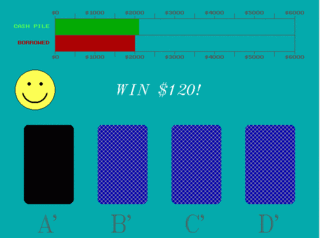
As it turns out, individuals with a history of NSSI were no more impulsive on either behavioral task than were the individuals with no history of NSSI. This result was actually fairly stunning, as it seems to indicate that individuals who self-injure are not necessarily particularly impulsive, given the definitions of impulsivity used in these tasks.
Study 2 extended these findings by using a more homogeneous sample of individuals who had recently self-injured and adding another behavioral task. The new task in this study measured impulsivity by considering delay discounting, which looks at the degree to which an individual is willing to accept an immediate smaller reward over a larger delayed reward. Here again, individuals with a history of NSSI self-reported higher levels of impulsivity than did individuals with no such history, but did not demonstrate higher levels of impulsivity on any of the behavioral tasks. By replicating the behavioral finding and adding a new behavioral measure, the authors increased confidence that their initial findings were not a fluke, which is important given that they were surprising.
These studies seem to support the idea that individuals who engage in NSSI are actually no more impulsive than are individuals who do not - that they simply self-report that they are more impulsive. This interpretation is certainly one possibility and, if it is true, it demonstrates the importance of using behavioral measures of impulsivity anytime we are considering that variable. Janis and Nock acknowledged another possibility however, and I tend to favor it: individuals who engage in NSSI might only be impulsive in certain contexts and those contexts might not be captured well by these computerized laboratory tasks. On a number of occasions, we have discussed Nock and Prinstein's functional model of NSSI (in fact, it was the topic of our first post when we launched PBB) and the data indicating that the desire to reduce negative emotions is the most common motivation for self-injury. This, of course, points towards negative urgency as the component of impulsivity most important to consider for this particular behavior. That being said, some of Dr.Nock's most influential work seems to indicate that the behavior is not something that occurs at random due to some overall deficit in self-control, but rather that it occurs in response to particular sensations (negative emotions). If NSSI is primarily motivated by negative emotions, particularly those that result from negative interpersonal encounters or other highly aversive life events, then computer tasks that do not involve any emotion might be unable to capture the components of impulsivity that are relevant to these individuals. In other words, if an individual tends to lose control of her behavior and become impulsive when she feels rejected by people close to her, this tendency might not show up when she is performing a computer task in which there are no interpersonal interactions.
Ultimately, Janis and Nock provided a great service with this study, as they made clear that a point many consider to be fact - individuals who engage in NSSI are highly impulsive - needs to be further considered. Because individuals with a history of NSSI demonstrated no more impulsivity on behavioral tasks than did individuals with no such history, we are left to debate at least two possibilities:
- Individuals with a history NSSI are actually no more impulsive than individuals with no such history - they simply self-report higher levels
- Our behavioral measures of impulsivity are inadequate, as they fail to consider the context of the behavior, which has become a focus of much of the research into impulsivity (e.g., Whiteside & Lynam, 2001).
If option 1 is the answer, what implications do you think this has for therapy? Should we no longer target impulsivity in treatment? If option 2 is the answer, how can we improve the behavioral tasks to better capture contextual issues like emotional precursors to maladaptive behaviors? I have some thoughts, but I would love to hear what you have to say on the issue.
************
If you would like to learn more about NSSI, we recommend the following resource, which is available through our online store for scientifically-based psychological resources:
- Understanding Nonsuicidal Self-Injury: Origins, Assessment, and Treatment
 by Matt Nock
Mike Anestis is a doctoral candidate in the clinical psychology department at Florida State University and an incoming resident at the University of Mississippi Medical Center


 Subscribe in a reader