
by Michael D. Anestis, M.S.
Suicide in the military has been one of the central components of my research over the past few years. In doing this, I have been privileged to collaborate with some amazing psychologists, some of whom are members of the military and some of whom are not. Late last year, Chad Morrow of the United States Air Force contributed a guest article about a study that several of us published examining suicide in Air Force personnel (click here to read the article). Today, I would like to quickly discuss an article published in the Journal of Clinical Psychology by PBB guest author Craig Bryan, PBB guest author Kelly Cukrowicz, Christopher West, and PBB guest author Chad Morrow (in press). I'm not going to repeat all of the information about the interpersonal-psychological theory of suicidal behavior, so if you are unfamiliar with the theory, I encourage you to read our previous discussions before going further here.
In this particular study, Bryan and colleagues (in press) compiled a sample of 522 service members deployed in support of Operation Iraqi Freedom (OIF). This, in and of itself, is a big deal, as previous research on the interpersonal-psychological theory in military samples have involved case studies or personnel not yet deployed. 151 of the participants were referred to an in-theater traumatic brain injury (TBI) clinic, 44 self-identified for routine services in an in-theater mental health clinic, and 327 took part in baseline psychological testing in case of future head injuries during deployment. The sample was thus a mix of clinical and non-clinical cases.
The authors hypothesized that combat exposure would predict the acquired capability for suicide, but would not predict either of the components of the desire for suicide (thwarted belongingness and perceived burdensomeness). In order to be sure that any relationship between combat exposure and the theory components was not better accounted for by other variables, the authors controlled for gender, past suicidality, PTSD symptoms, and depression symptoms.
So what did they find? Combat exposure did, in fact, significantly predict the acquired capability, although it accounted for only a small portion of the variance. In other words, combat exposure accounted for some degree of why different individuals scored differently on the acquired capability, but other variables play a bigger role. The authors raised some interesting thoughts as to why this might be the case. First of all, it is entirely plausible that the intensive training that takes place prior to deployment into combat could elevate the average level of the acquired capability high enough that combat exposure does not add all that much to what has already been gained. Alternatively (or additionally), it might be that individuals who enroll in the military already have the elevated physiological pain tolerance and diminished fear of death that comprise the acquired capability. Here again, because initial levels are already so high, it might be difficult for combat exposure to account for all that much variability. Future research utilizing a number of time points, tracing the progress of individuals' acquired capability from the time they enter the military (or before) would help us answer this question.
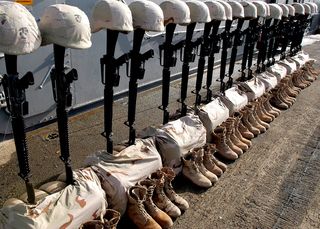
Bryan and colleagues (in press) also found that, as expected, combat exposure did not predict the desire for suicide. Keep in mind that the current state of affair, in which suicide rates in the military are higher than civilian rates, is unique in history. Traditionally, the opposite has been true and many have explained this state of affairs to the fact that soldiers often form strong bonds with fellow soldiers (increased belongingness) and feel that they are making an important contribution to the world (decreased burdensomeness). As a result, although soldiers develop a vastly enhanced capability for suicide, they do not necessarily ever experience the desire. Combat exposure on its own, it seems, does not account for increases in that desire. Instead, when solders experience suicidal ideation, this is better accounted for by depression symptoms, PTSD symptoms, and a number of other related but distinct ideas.
So what does this study tell us? It appears that when soldiers are exposed to combat, their capability for enacting lethal self-harm increases. Their desire for suicide, on the other hand, is unrelated to combat exposure. Future research will tell us more about the mechanisms that drive suicidal behavior both in the military and in civilian populations, but this study marks an impressive step forward in empirical investigations on suicide in this particular segment of the population.
************
If you would like to learn more about suicide or other topics discussed on Psychotherapy Brown Bag, we hope you will consult our online store for scientifically-based psychological resources. Additionally, if you or anyone you know is experiencing thoughts of suicide, please remember that 1-800-273-TALK is a free, 24/7 service available to those in need.
Mike Anestis is a doctoral candidate in the clinical psychology department of Florida State University and an incoming resident at the University of Mississippi Medical Center.


 Subscribe in a reader