
by Michael D. Anestis, Ph.D.
As the director of the Suicide and Emotion Dysregulation lab at the University of Southern Mississippi, I spend a good deal of time researching risk and protective factors for suicide, both in the military and civilians. I find the work rewarding, but at times I worry that the science we conduct in our lab lacks a voice capable of reaching a broad enough audience. Generally speaking, loud voices are not how science works - and that's not always terrible - but there are situations in which a greater reach would be useful.
The other day, several of my students and I had a paper published in the American Journal of Public Health and I believe this paper represents one of those times when a loud voice is necessary. Our paper addresses a controversial topic: legislation that regulates handgun ownership. Conversations on this topic almost always turn into emotional conflicts driven by political views - many feel strongly on this issue - but my hope is to keep the conversation focused on the data, as I think they tell a very clear story independent of personal views.
In this paper, we wanted to clarify the relationship between firearms legislation and suicide. To do this, we looked at three specific state laws regulating handgun ownership: (1) requirement of a permit to purchase a handgun, (2) requirement of a license to own a handgun, and (3) requirement to register handguns that have been purchased. One concern we had going into this project was that individuals who oppose any legislation regulating handgun (or other firearm) ownership would accuse us of bias and dismiss our findings, arguing that we pushed the scales in the favor of our results. To guard against this, we selected the three laws mentioned above by consulting the website of the National Rifle Association Institute for Legislative Action (NRA-ILA), which tracks these specific laws on a state-by-state basis. Our thought was, if the NRA finds these laws important to track, they could not argue against their selection.
We had three specific hypotheses. Using data from 2010 (the most recent available data at the time we were extracting it), we believed that:
- States with these laws in place would have lower overall suicide rates (individuals per 100,000 who died by suicide), lower firearms suicide rates, and a lower percentage of suicide deaths resulting from firearms, even after accounting for the effects of poverty and population density
- The relationship between the laws and overall suicide rates would be indirect through the percentage of suicide deaths resulting from firearms.
- States that implemented any of these laws during the time period for which data were available would exhibit decreased suicide rates in the years following implementation
Before reporting the results from those three questions, we noted some starting numbers
|
States with 9 Highest % of Suicides Due to Firearms |
States with 9 Lowest % of Suicides Due to Firearms |
|
|
Population (% of Nation) |
31,001,858 (10.0%) |
91,090,901 (29.5%) |
|
Suicide Deaths |
4,252 (11.1%) |
8,685 (22.6%) |
|
Firearm Suicides |
2,772 (14.3%) |
2,906 (14.9%) |
As you can see from that table, there were more than 60 million more people in the 9 states with the lowest percentages of suicide deaths resulting from firearms relative to the 9 states with the highest percentatges, but only approximately 130 additional suicide deaths by firearms. These states were underrepresented in overall suicide rates.
But what about differences at the state level?
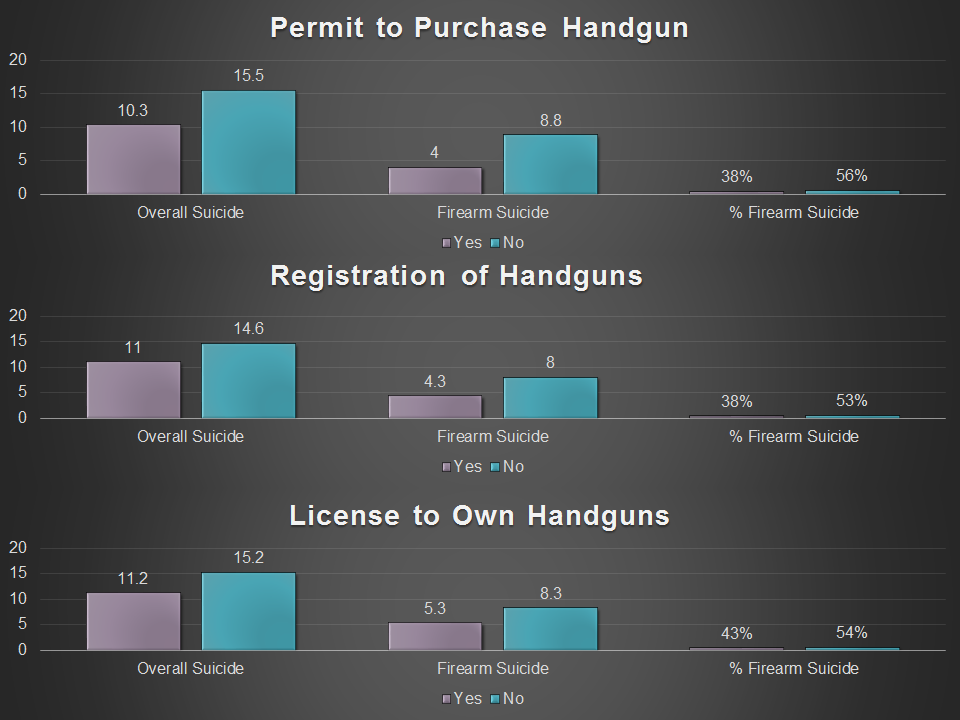
As you can see, here again the results are clear. States with such laws in place exhibited substantially lower suicide rates - overall and resulting from firearms - than did states without such laws in place. These tables, however, did not account for poverty and population density. So what happens when we factor those variables in?
|
|
Statewide Suicide Rate for 2010 |
Statewide Suicide by Firearm Rate for 2010 |
Statewide Proportion of Suicide Deaths by Firearms for 2010 |
||||||
|
|
R2 |
F |
pµ2 |
R2 |
F |
pµ2 |
R2 |
F |
pµ2 |
|
|
.44 |
|
|
.50 |
|
|
.52 |
|
|
|
% of State Below Poverty Line |
|
.87 |
.02 |
|
.59 |
.01 |
|
10.34** |
.18 |
|
Population Density |
|
2.35 |
.05 |
|
2.89 |
.06 |
|
5.24* |
.10 |
|
Permit to Purchase Handguns |
|
23.79*** |
.34 |
|
27.20*** |
.37 |
|
16.43*** |
.26 |
|
|
.19 |
|
|
.28 |
|
|
.43 |
|
|
|
% of State Below Poverty Line |
|
.26 |
.01 |
|
4.25* |
.08 |
|
18.11*** |
.28 |
|
Population Density |
|
4.47* |
.09 |
|
4.30* |
.08 |
|
5.65* |
.11 |
|
Registration of Handguns |
|
2.08 |
.04 |
|
4.62* |
.09 |
|
6.28* |
.12 |
|
|
.29 |
|
|
.31 |
|
|
.41 |
|
|
|
% of State Below Poverty Line |
|
.13 |
.00 |
|
3.99 |
.08 |
|
17.10*** |
.27 |
|
Population Density |
|
4.03 |
.08 |
|
5.07* |
.10 |
|
7.54** |
.14 |
|
License to Own Handguns |
|
8.99** |
.16 |
|
6.86* |
.13 |
|
4.52* |
.09 |
Only the effect of registration laws on overall suicide rates became non-significant, meaning that nearly all of our effects still held. Most importantly - and I know this sounds technical - but pay attention to the "partial eta squared" values. These are measures of effect sizes, which tell you how powerful a relationship is. Values above .16 are considered large - and those are rare in social science research - and yet you'll notice several of ours are well above that.
What about our second question? We ran a series of analyses referred to as test of indirect effects and found that all three laws had significant total effects on overall suicide rates and that both the registration and license laws had significant indirect effects through the percentage of suicide deaths resulting from firearms. This could mean one or more of several things: individuals in states with these laws attempt suicide less often, attempt using less lethal means, or have fewer handguns in their homes. Regardless, the findings indicate that the laws work by reducing the frequency of death using the most lethal means for suicide.
And what about question #3? Unfortunately, very few states had any changes in these laws during the time period for which we had data. This prevented us from running the types of analyses I would prefer to run and you should thus consider the data below somewhat preliminary. In 2003, California and Maryland both implemented laws requiring a license to own a handgun. Notice how their suicide rates changed following implementation:
|
|
United States |
Yes License |
No License |
California |
Maryland |
|
|
|
|
|
|
|
|
% Change in Suicide Rate from 2001-2006 |
3.8% |
0.8% |
2.9% |
12.8% |
0.6% |
|
% Change in Suicide Rate from 2001-2003 |
0.9% |
-4.6% |
0.3% |
17.4% |
5.7% |
|
% Change in Suicide Rate from 2003-2006 |
2.9% |
5.8% |
2.6% |
-3.9% |
-4.8% |
As you can see, after Maryland and California implemented license laws in 2003, their overall suicide rates declined whereas all other categories saw increases.
So what's the take home message here? It appears that handgun legislation could have a robust role in reducing overall suicide rates on a large scale. It also appears that this is likely to exert its effect by reducing the percentage of suicide deaths that result from firearms, which in turn is associated with overall reductions in suicide. Lastly, although the data were limited, it also appeared that, in the years following implementation, states that instituted one of these laws saw a decrease in suicide rates even as the rest of the country saw a continued rise in suicides.
Legislation won't solve everything, but it doesn't have to solve everything to be important. Suicide is a catastrophic health care outcome. If we are serious about addressing it, we need to be able to have open conversations about the tools available to us to do so - even when those topics can lead to strong emotional responses. I encourage each of you to closely consider the data presented here. Folks who do not like these numbers will likely raise concerns that they suggest that the government violate freedom - the centerpiece of our country. I would disagree with that assertion and would counter with the notion that suicide prevention is very much an American virtue and that, given increased rates of suicide in our servicemen and women in recent years, concerted efforts to reduce suicide through all means available are highly consistent with the moral compass of our nation.
**********
Dr. Mike Anestis, Ph.D. is the director of the Suicide and Emotion Dysregulation lab and the Nina Bell Suggs Professor of Psychology at the University of Mississippi.
I would note that the views expressed in this piece are my own and not of my employer or anyone else.


 Subscribe in a reader