
by Michael Anestis, Ph.D.
Over the past handful of months, I have written about a couple studies colleagues and I have published in the American Journal of Public Health on the association between state laws regulating handgun ownership and statewide suicide rates. I was very pleased to see these studies pick up some reasonably strong press coverage, with articles in the New York Times, Los Angeles Times, CNN, Charleston Gazette, and others, as well as an interview on Mississippi Public Broadcasting. Media coverage like that extends the conversation about science to a broader audience and keeps the conversation moving. Given our finding that universal background checks appear to have the most robust association with overall suicide rates, I was also extremely pleased to see President Obama’s decision to take action on extending background checks beyond their current limits. Another positive in all of that is that it has allowed me to hear follow-up questions from readers and listeners, which in turn has prompted several other recently published studies that I would like to discuss today.
Before jumping into these studies though, I'd like to take a moment to note a disturbing trend. The US is understandably horrified by mass shootings. They are a horrific occurrence and those who die in such conflicts and the families and friends they leave behind should be in our thoughts daily. That being said, the large majority of gun deaths in the US are suicides and yet the conversation almost never even includes (nevermind focuses on) suicide. If folks are serious about ending gun violence, they need to start talking about the source of most gun deaths. If folks are serious about addressing public health concerns, they need to stop avoiding discussing of the 10th leading cause of death in the United States.
Veterans, handgun legislation, and suicide rates
The first study I’d like to discuss was just published in the Journal of Psychiatric Research. My colleague Dan Capron and I extended the handgun legislation papers to consider the associations between state veteran population rates (number of veterans per 100,000 citizens in a state), handgun legislation, and statewide suicide rates. The elevated suicide rates in active duty military personnel, National Guard and reserve personnel, and military veterans is well known and we were interested in taking a look at several factors that might at least partially explain that phenomenon.
The first point we wanted to highlight was the salience of veteran population rate in statewide suicide rates. Although not a particularly surprising finding overall, we thought the magnitude of the effect might be noteworthy and, indeed, even after controlling for important demographic characteristics (age, education levels, population density, poverty, race/ethnicity), we found that the veteran population rate predicted the overall state suicide rate, state firearm suicide rate, and proportion of suicides in a state resulting from firearms. In each case, we accounted for an enormous amount of the variance in these outcomes and the effect size was enormous. This first analysis highlights the fact that states with populations heavily saturated with veterans tend to exhibit substantially elevated suicide rates (overall and by guns alone).
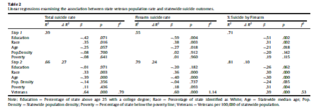
The second point we wanted to address was why veteran population rate might be associated with the overall (not just gun) state suicide rate. Our assumption was that this difference would be explained by a tendency for a higher proportion of suicides having resulted from guns in states with a greater veteran population rate. To examine this, we ran a test of indirect effects, which examines the extent to which one variable (percentage of suicides resulting from firearms) explains the relationship between two other variables (state veteran population rate and state overall suicide rate). These results very clearly supported our contention in that, not only was there a direct link between veteran population rate and overall suicide rate, but there was also a significant indirect effect through the percentage of suicides resulting from firearms, again with an extremely large effect size. This second analysis highlights that the elevated suicide rates in states more heavily saturated with veterans is at least partially explained by the tendency for a greater proportion of suicides in such states to result from self-inflicted gunshot wounds.

The third and final point we wanted to address was whether veterans tend to make up a higher percentage of the population in states that do not have laws in place that have previously been shown to be associated with lower overall suicide rates (universal background checks, waiting periods, gun lock requirements, restriction of open carry – all laws specific to handguns). Here again, we found support for our hypothesis, with large effect sizes indicating that states without handgun legislation in place previously shown to predict lower suicide rates tend to have populations more heavily saturated with veterans.
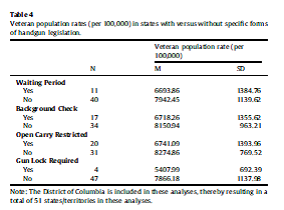
So what does all of this tell us? We already know that several state laws regulating access and exposure to handguns predict lower overall suicide rates. This paper demonstrated that states with populations more heavily saturated with veterans tend to have substantially higher overall suicide rates, that this point is largely explained by the tendency of veterans to use guns in their suicide attempts, and that all of this might be facilitated by the fact that veterans tend to cluster in states with minimal handgun legislation in place.
Safe Storage of Guns and Military Suicide
The second study I want to discuss was published in Military Psychology. My co-authors were two of my doctoral students – Lauren Khazem (lead author) and Claire Houtsma – along with Kim Gratz and Matthew Tull of the University of Mississippi Medical Center. The data came from my Military Suicide Research Consortium funded grant examining suicide risk in the National Guard. Our sample was comprised of just under 1,000 soldiers, almost all of whom were soldiers in the Army National Guard (with nearly half demobilizing from deployment at the time of the baseline assessment). We were interested in the extent to which the manner in which soldiers store their personal firearms was associated with suicide risk and, as such, only included National Guard personnel who endorsed owning a private firearm (432 soldiers).
The full model we proposed was a little more complicated than that though. Following the logic of Klonsky and May’s Three Step Theory of Suicide, we noted that access to and familiarity with lethal means (e.g., guns) is an important component of the capability for suicide and a factor that can facilitate the transition from thinking about suicide to making a suicide attempt. What much of the public doesn’t necessarily know is that the vast majority of those who think about suicide do not make and attempt and the vast majority of those who make an attempt do not die. So it is incredibly important that our studies help us understand the factors that drive the transition along that continuum of risk in order to better differentiate those who will only think about suicide from those who will make an attempt. Along these lines, we had three hypotheses.
- Soldiers who stored their guns unsafely (loaded and in an unsecure location vs unloaded and/or in a secure location) would exhibit greater fearlessness about death (another important component of the capability for suicide).
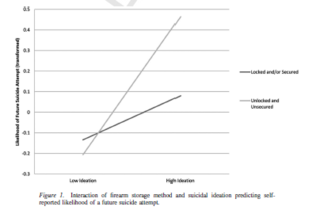
- Storing personal firearms unsafely would increase the strength of the relationship between current thoughts of suicide and the belief that suicide was a likely outcome in the future
- The effect from hypothesis 2 would be explained by fearlessness about death.
What we found was substantial support for the first two of those hypotheses. Soldiers who stored their guns unsafely reported significantly greater fearlessness about death. Furthermore, storing a personal firearm unsafely significantly increased the strength of the relationship between suicidal ideation and the belief that suicide was a likely outcome in the future.
Fearlessness about death did not explain the findings for hypothesis two, which means the impact of unsafe storage on the relationship between ideation and the belief that suicide is likely in the future is explained by something other than fearlessness.
So what is the take home message here? On a basic level, the findings highlight that how an individual stores their gun matters and can impact the way that they think about suicide. Now, it’s important to note that gun storage was not associated with suicidal ideation itself – so unsafe storage does not cause somebody to think about suicide. Instead, unsafe storage appears to potentially impact the extent to which thinking about suicide more broadly is associated with developing the belief that suicide is likely in the future. So in this sense, unsafe storage could facilitate the transition from ideation to action.
On a broader level, these findings highlight a potential area for common ground between gun control advocates and gun owners. Gun safety does not necessarily have to involve removing guns (at least permanently – it is highly advisable that suicidal individuals allow somebody to temporarily hold their gun for them while they experience thoughts of suicide or severe depression). Instead, it could involve the development of a culture of safety in which gun owners promote the importance of safe storage in suicide prevention. There is a model for this, as many areas mandate safe storage training in the prevention of accidents. The effectiveness of such efforts can be seen in the remarkably low level of accidental gun deaths that occur (in my state – Mississippi – fewer than 20 accidental firearm deaths occurred in 2013 as compared to approximately 200 firearm suicides).
Firearm suicides and prior suicidal behavior
The final study I want to discuss is one that I published recently in the Journal of Affective Disorders. In this one, I was interested in the extent to which suicide decedents who died from a self-inflicted gunshot wound differ from suicide decedents who died by other means in terms of prior suicidal behavior. The rationale here is that two of the most important factors used in evidence-based risk assessment procedures to determine imminent risk are the presence of suicidal ideation and a history of prior suicide attempts (in many ways a proxy for suicidal desire and the capability for suicide). We already know from prior research that certain populations (e.g., veterans, older adult males) are more prone than others to use guns in their suicide attempts and that these individuals are also prone to underreporting suicidal ideation. Because of this, these individuals are unlikely to seek out mental health care and our ability to implement evidence-based treatments for suicidality is limited because they do not identify themselves. I was curious whether those who die by suicide using a gun also report a lesser tendency to engage in previous suicide attempts (by any means). If this were the case, it would mean that, in addition to their tendency to underreport suicidal ideation, those who die using a gun are also less likely to encounter our mental health system as a result of a prior attempt (e.g., presenting in an emergency room after an intentional overdose and being referring for mental health treatment).
To address this, I used data from the National Violent Death Reporting System (NVDRS). Using data from 2005 through 2012, I was able to examine the profiles of 71,775 suicide decedents across 17 states. What I found was that, in each individual state, suicide decedents who died from a gun were less likely to have had a prior suicide attempt than were individuals who died by suicide through other methods. This was obviously then also true for the full sample, with 12.10% of firearm suicide decedents having survived a prior suicide attempt as compared to 28.66% of suicide decedents who died through other means.
This finding points to a glaring hole in our current prevention and treatment efforts. Suicidal ideation and prior suicide attempts are still remarkably important variables to consider when determining risk, but clinicians (and legislators) need to realize that our current system is in many ways ill equipped to reach the individuals most likely to die using the most common method of death in US suicides. Increasing the reach of our mental health system is a noble goal, but if the individuals most likely to die by suicide using a gun do not seek out mental health services, deny suicidal ideation when asked, and never present in health care settings as a result of a prior suicide attempt, extending the reach of that system seems highly unlikely to reach these individuals. We need to adjust our approach and, in doing so, directly address the means – guns – most likely to cause death. Whether that means legislation or simply the development of safe storage standards and open communication about the importance of managing a gun properly when suicide risk is high, steps need to actively be taken in order to address this situation.
Concluding thoughts
As folks read this, I suspect a sizable number of readers will actively wonder whether focusing on guns is missing the point. After all, many believe that if an individual who wants to die is prevented from using a gun, they will simply use another method. This idea is called method substitution and it has been repeatedly debunked through research. I could expand upon this further, but this post is getting a bit long. Let me sum it up succinctly though with a directly relevant example. If addressing guns would simply lead to folks dying by other means, the legislation papers we discussed before would not have found an association between handgun legislation and the overall suicide rate. They would have only found an association between the laws and the firearm suicide rate. As we noted though, this did not happen. The presence of laws regulating access and exposure to handguns was associated – both cross-sectionally and longitudinally – with reductions in the overall suicide rate. The is clear evidence that, when you make the most lethal method frequently used in suicide deaths harder to access, fewer people die by suicide.
**********
Dr. Mike Anestis is the Nina Bell Suggs Professor of Psychology and the Director of the Suicide and Emotion Dysregulation laboratory at the University of Southern Mississippi


 Subscribe in a reader